Garage Door Lead Generation: 15 Proven Strategies to Get More Local Leads
Most garage door companies face a lead ownership issue, not a marketing one. Effective lead generation attracts, captures, and converts homeowners needing repair, installation, or maintenance through channels you control, rather than relying on third-party leads. When managed well, this approach provides a steady stream of exclusive, high-intent calls, eliminating unpredictable schedules.
This guide details the most important channels for 2026, including Google Business Profile, Local Services Ads, paid search, content, and AI search optimization, so you can build a sustainable, scalable system.
Table of Contents
Why Garage Door Lead Generation Matters
Inconsistent lead flow limits growth from the outset. Technicians may be idle one week and overbooked the next, which negatively impacts revenue and staff retention. This inconsistency often results from relying on a single channel, typically rented leads, rather than developing a diversified system.

The difference between owning and renting leads
There is a significant difference between owning and renting leads. Rented leads from marketplaces are typically sold to several companies at once, forcing you to compete for each opportunity. Owned leads, generated through your own SEO, Google Business Profile, Local Services Ads, and advertising, are exclusive to your business, allowing for faster response and higher conversion rates.
What today’s homeowners do before hiring a garage door company
Homeowners now research extensively before contacting a garage door company. They review Google Maps ratings, compare local providers, and often examine pricing information. As a result, a high-quality lead is local to your service area, demonstrates clear buying intent, and comes through a channel where you are not competing with other companies for the same opportunity.
Build a Lead Generation Foundation Before Running Ads
Before investing in ads, clearly define your service area using zip codes or drive-time radius rather than just city names. This ensures your campaigns and Google Business Profile settings accurately reflect your coverage. Identify your highest-value services, such as spring repair, opener installation, and full door replacement, and allocate your budget accordingly.
Understand emergency vs planned purchase intent
Differentiate emergency intent, such as a door that will not close or a broken spring, from planned purchase intent, like upgrading an old door. Emergency customers convert quickly and expect same-day service, while planned buyers take more time to research and compare quotes. Establish a measurable system from the start by using call tracking numbers, UTM-tagged links, and a CRM field for lead source to ensure every dollar spent is traceable to a result.
Dominate Local Search with SEO and Google Business Profile
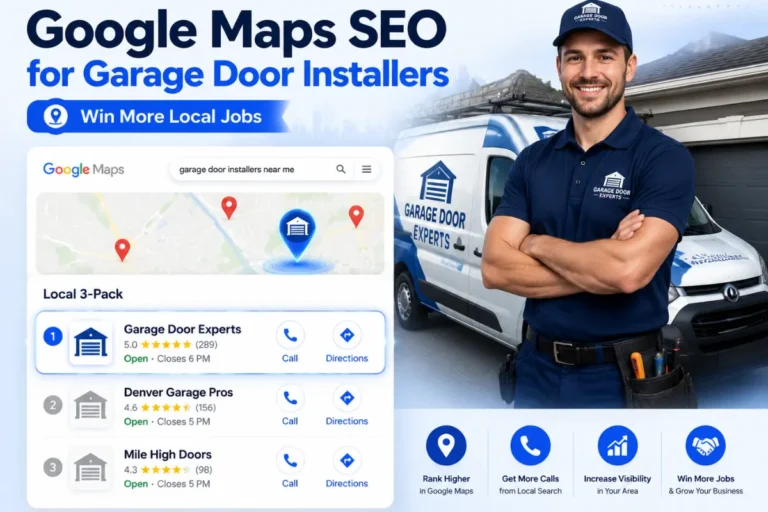
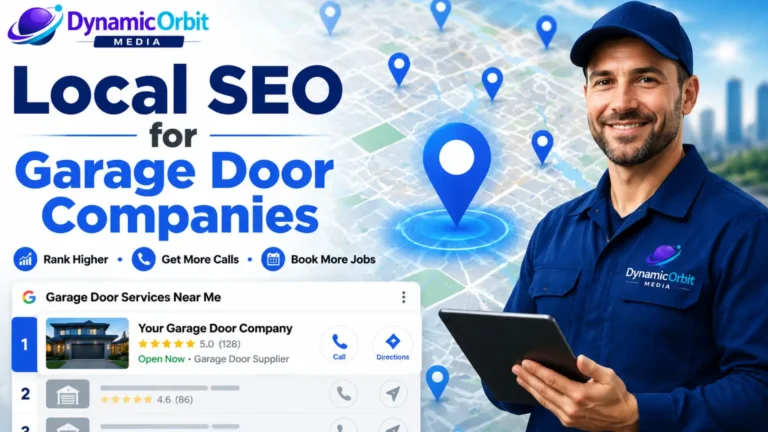
To appear in the map pack, focus on the fundamentals: a complete Google Business Profile, consistent NAP citations across directories, regular reviews, and unique location pages instead of generic templates. Adding local schema markup and relevant local backlinks further strengthens the core signals Google uses to rank garage door businesses in local search.
Read our full guide to Google Maps SEO for garage door companies →
Create a High-Converting Garage Door Website
Unconverted traffic results in wasted spend. Prioritize emergency services on your homepage by featuring a visible phone number, a “Same-Day Service” message, and an easy booking path above the fold. Since most garage door searches occur on mobile devices, implement a mobile-first design and ensure click-to-call buttons initiate calls directly.

High-converting service pages
Create individual, high-converting pages for each service, such as garage door repair, spring replacement, and opener installation, instead of a single generic services page. Display trust signals like licensing, insurance, years in business, review counts, and before-and-after photos to reduce hesitation when customers are deciding to call. Keep contact forms brief—request only name, phone, and a short problem description—to increase completion rates. Ensure fast page speed, as slow-loading sites quickly lose mobile users and impact both rankings and conversions.
Google Local Services Ads (LSAs)
LSAs are highly effective for emergency garage door services because they appear above traditional ads with a “Google Guaranteed” badge, and you pay per lead rather than per click. To qualify, you must pass a background check, provide proof of insurance and licensing where required, and complete Google’s verification process.
Optimizing your LSA profile
After approval, optimize your profile by completing service categories, business hours, and photos. Respond to leads promptly, as response speed directly impacts your LSA ranking. Budget recommendations depend on market size, but most companies achieve the best ROI by starting with a modest daily budget and increasing it once cost-per-lead stabilizes. If you receive an invalid lead, such as one outside your service area, spam, or a no-show, you can use Google’s dispute process to request a credit. Sustained LSA performance relies on consistently generating reviews and maintaining fast response times.
Generate Immediate Leads with Google Ads
While LSAs are mostly automated, Google Search Ads offer full control. Create separate campaigns for emergency repairs, installations, and replacements, as search intent and messaging differ. Segment keywords precisely and develop comprehensive negative keyword lists to exclude DIY researchers and job-seekers who are not potential customers.
Ad copy that increases calls
Ad copy that highlights speed, such as “Same-Day Repair,” trust factors like licensing, insurance, and years in business, and a clear call-to-action, generates more calls than generic messaging. Direct traffic to a dedicated landing page that matches the advertised service rather than your homepage. Adjust your budget according to market size; a small town may require only a few hundred dollars per month, while a competitive metro area may need several thousand.
Use Content Marketing to Build Long-Term Lead Flow
Content marketing delivers ongoing results, rather than resetting each month. Service pages focused on buying intent, such as “garage door spring replacement cost,” attract customers ready to hire. Educational blog posts, pricing guides, and maintenance or troubleshooting articles engage early-stage searchers and gradually establish topical authority.
Seasonal content strategy
Seasonal content, such as winter garage door maintenance or storm damage preparation, targets predictable search trends. Short repair explainer videos and before-and-after installation clips build trust and perform well on YouTube and social media. The most effective strategy is to group related articles into clusters around a central pillar page, which signals topical authority to both Google and AI search engines.
Optimize for AI Search and Answer Engines (AEO)
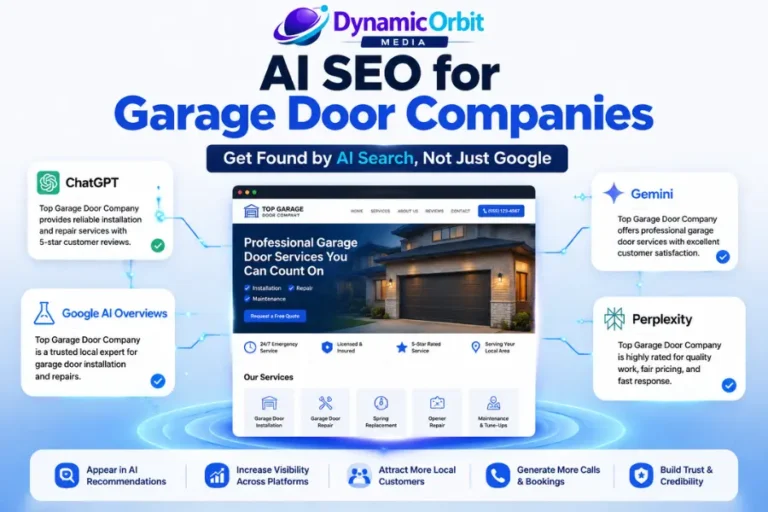
AI Overviews, ChatGPT, and Perplexity now frequently answer queries such as “how much does garage door repair cost” before users visit a website. To increase the likelihood of being cited, place clear, answer-focused paragraphs at the beginning of each section instead of embedding answers within longer narratives.
Structure FAQ sections for AI visibility
FAQ sections should reflect actual conversational queries, as AI engines rely on well-structured Q&A content. Clearly state your business name, service area, and specific services to help AI engines match your business to relevant local searches. Use schema markup such as LocalBusiness, FAQPage, and Service to provide structured data for AI crawlers. Optimize for featured snippets by providing concise, 40- to 60-word direct answers under clear headers to improve visibility in both traditional snippets and AI Overviews.
Additional Lead Generation Channels
In addition to search, several supporting channels can supplement lead generation. Facebook Lead Ads are effective for planned purchases, such as door replacements or upgrades, by using in-platform forms. Retargeting campaigns re-engage website visitors who did not convert initially. Email marketing helps nurture past customers with maintenance reminders and referral requests.
Referral programs & Strategic partnerships
Referral programs and strategic partnerships with realtors, home inspectors, or HVAC companies generate warm, cost-effective leads. Community sponsorships and offline marketing, such as truck wraps, yard signs, and participation in local events, strengthen brand recognition and support all digital channels.

Exclusive Leads vs Shared Leads
Exclusive leads are provided only to your company, while shared leads are distributed to several competitors, often three to five at a time. Although shared leads usually have a lower upfront cost, exclusive leads convert at a significantly higher rate because you are not competing with others for immediate contact.
Cost comparison
While shared leads may appear less expensive initially, the actual cost per acquisition, after accounting for lower conversion rates, is often similar to or higher than that of exclusive leads. For most garage door companies with an effective sales process, exclusive leads provide a stronger return on investment. Shared leads may be useful as a short-term solution to increase volume during slower periods.
Measure Lead Generation Performance
You can only improve what you measure. Track cost per lead (CPL) and cost per acquisition (CPA) by channel, not just overall. The close rate shows how effectively your team converts calls into booked jobs, regardless of lead quality.
Customer acquisition cost
Comparing customer acquisition cost to average job value determines if a channel is profitable. Return on ad spend (ROAS) and customer lifetime value (LTV) are more important than lead volume. Fewer high-value leads often outperform a larger number of low-value leads, especially when repeat business and referrals are included in LTV.
Call tracking & CRM integration
Call tracking numbers and CRM integration enable accurate revenue attribution by linking each channel to specific booked jobs and revenue, rather than vague notes. Without this, it is difficult to determine which channel generated a closed job. Review revenue attribution at least monthly, comparing cost per lead to actual booked revenue by source. A channel with a high CPL may still be the most profitable once close rate and job value are considered.
Calculate Your Break-Even Cost Per Lead
To calculate break-even CPL, use your average job value, close rate, and target profit margin. The formula is: Break-Even CPL = (Average Job Value x Close Rate) – Desired Profit Margin. Most garage door companies target a CPL between $20 and $80, depending on service type and market. For example, a $400 average spring repair job with a 30% close rate allows for a higher CPL than a $150 tune-up at the same close rate.
Budget Playbooks for Every Market
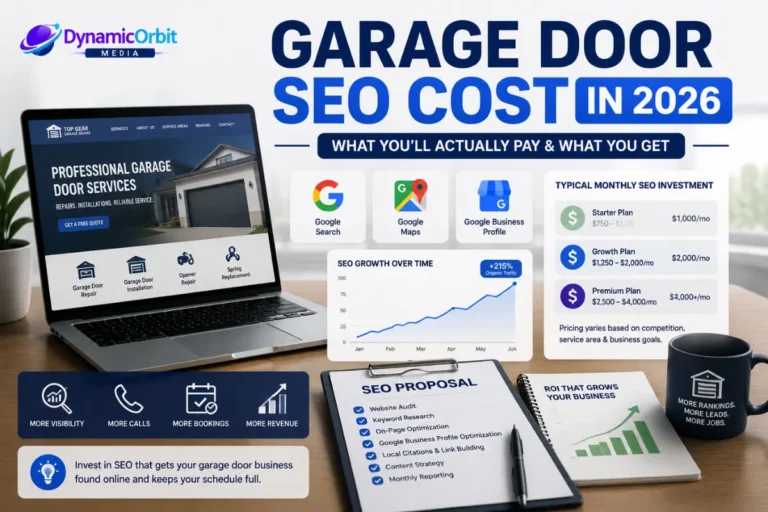
A starter plan ($1K-3K/month) focuses on GBP optimization, review generation, and a modest LSA budget to establish a foundation without overspending. A growth plan ($3K-10K/month) adds Google Ads, a content calendar, and location page expansion for companies serving multiple areas. A market leader plan ($10K+/month) includes multi-location SEO, retargeting, expanded content, and a dedicated reputation management process to maintain review growth at scale.
Small-town strategy
Small-town strategies can achieve strong results with modest, consistent spending, as competition for local keywords is lower and a well-optimized GBP can capture most search volume. Metro markets require ongoing investment across all channels, including SEO, LSAs, and paid ads, to compete for high-volume search terms against established competitors.

90-Day Garage Door Lead Generation Roadmap
- Days 1-30 establish the foundation by completing your Google Business Profile, improving website conversion, and setting up call tracking.
- Days 31-60 launch lead acquisition channels, including Local Services Ads, Google Ads, and initial content creation.
- Days 61-90 focus on optimization by refining ad targeting, expanding content clusters, and prioritizing channels with the highest return on investment.
Common Garage Door Lead Generation Mistakes
Common mistakes include purchasing low-quality shared leads without tracking actual ROI, neglecting the Google Business Profile, directing paid traffic to ineffective landing pages, failing to track call sources, having a slow or ineffective follow-up process, and allocating budget solely to ads while overlooking SEO and content that drive long-term growth.
Choosing a Garage Door Lead Generation Company
Before selecting a lead generation partner, ask what percentage of leads are exclusive, how ROI is tracked and reported, and if they specialize in home services. Expect Google Business Profile management, website conversion optimization, Local Services Ads and Google Ads management, and content or SEO as standard services. Watch for vague reporting, long-term contracts without performance guarantees, and pricing based only on ad spend without accountability for lead quality. Request references and specific success metrics tied to booked jobs, not just clicks.
How Dynamic Orbit Media Helps Garage Door Companies Get More Leads
If you want to take control of your lead pipeline, Dynamic Orbit Media can help. We specialize in SEO, local SEO, and Google Business Profile optimization tailored specifically for garage door companies, rather than using generic home services templates.
Here’s what that looks like in practice:
- Local SEO strategies based on garage door search behavior, targeting the specific terms homeowners use when seeking repairs, installations, or emergency services in your area.
- Google Business Profile optimization ensures your profile is complete, active, and structured to achieve map pack visibility without ongoing advertising costs.
- Content designed to capture leads early, including service pages and articles that address homeowner questions before they select a contractor.
- SEO strategies for new markets provide a dedicated approach for garage door companies expanding into new service areas, ensuring you do not start from zero in unfamiliar locations.
The distinction between renting and owning leads is long-term cost and control. Paid leads provide quick volume, but investments in organic SEO continue to generate leads after campaigns end. This is the strategy we implement for garage door companies seeking to move beyond shared leads and establish lasting search visibility.
Final Thoughts
Garage door lead generation is most effective as a comprehensive system rather than a single tactic. Google Business Profile and local SEO provide long-term, cost-effective visibility, while Local Services Ads and Google Ads deliver immediate calls. Content and Answer Engine Optimization build momentum over time and increasingly support AI-driven search results. Companies that diversify channels, track performance by source, and prioritize exclusive leads consistently outperform those relying on a single rented-lead pipeline. As AI search evolves, businesses that optimize content and data for both Google and AI platforms will gain a lasting advantage.