Reputation Management for Roofing Companies: Get More Reviews
Most homeowners form an opinion of your roofing company before they call. They review your Google ratings, read recent feedback, and often check how you address complaints. This judgment typically takes less than two minutes and often determines whether they contact you or a competitor.
Reputation management for roofing companies involves consistently building, monitoring, and protecting your online image. For major purchases like roof replacements, which often exceed $10,000, reviews are among the most influential factors for homeowners. This guide covers the essentials of reputation management, how to build a reliable review-generation system, effective ways to respond to feedback, and the link between your reputation and Google rankings.
Table of Contents
What Reputation Management Actually Involves
Reputation management for roofing companies means actively shaping your business’s presence on every platform where homeowners may research you, including Google Business Profile, Yelp, Facebook, Nextdoor, Angi, and the Better Business Bureau. This ongoing process includes requesting reviews at appropriate times, responding to all feedback, monitoring listings for accuracy, and addressing operational issues that could lead to negative reviews.
Online reputation management is especially important for roofing companies due to the higher cost of services. While homeowners may do minimal research for a $200 plumbing repair, they typically read multiple reviews, evaluate responses to negative feedback, and compare ratings across several roofing contractors before choosing one for a $15,000 replacement.
Where Your Roofing Company’s Reputation Actually Lives
Your reputation extends across multiple platforms, each influencing homeowners’ decisions in different ways.
| Platform | Why It Matters for Roofers |
|---|---|
| Google Business Profile | The most influential platform for local rankings and the first thing most homeowners see in the Map Pack |
| Yelp | Carries weight with homeowners doing broader comparison shopping, especially in urban markets |
| Builds community trust and is often where neighbors tag or recommend a roofer directly | |
| Nextdoor | Increasingly common for roofing recommendations, since neighbors trust other neighbors after a storm |
| Angi and BBB | Supplemental trust signals, particularly for homeowners who were burned by a contractor before |
Google Business Profile should be prioritized, as it directly affects Map Pack visibility. Roofing companies with more recent and higher-rated reviews gain a significant advantage in local search results, independent of traditional website SEO.
How to Build a Review Generation System
The primary reputation challenge for roofing companies is not negative reviews, but a lack of reviews overall. Satisfied customers seldom leave feedback unless prompted, while dissatisfied customers are more likely to. Without a consistent process, your review profile may not accurately reflect the quality of your work.
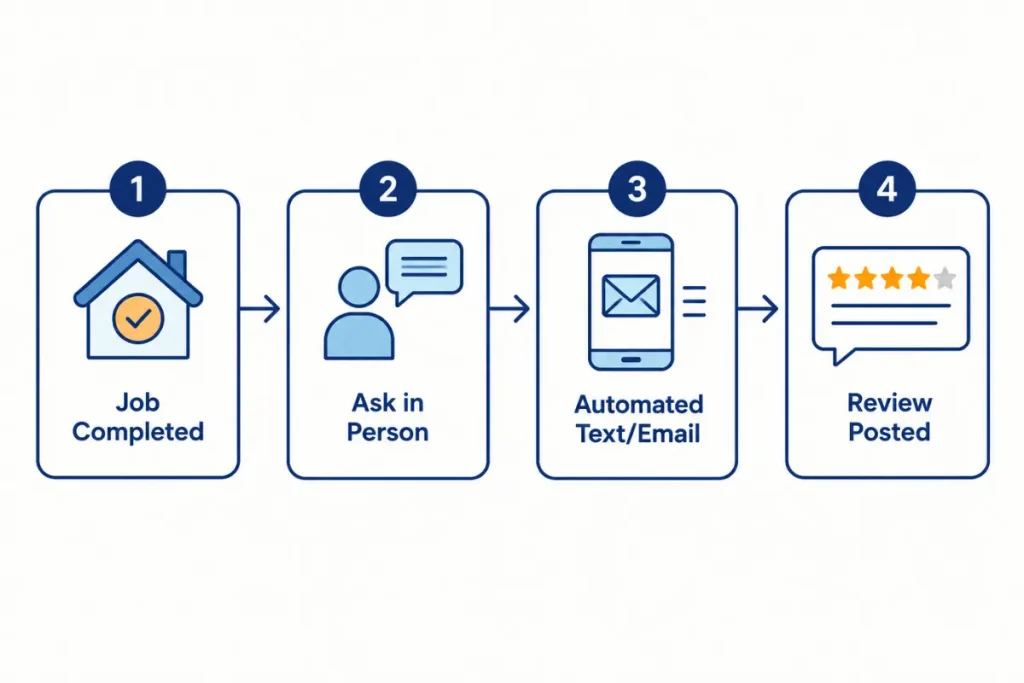
A review generation system for roofers typically includes:
- Asking at the right moment. Request a review immediately after a job is completed and the customer is satisfied, not weeks later when the experience has faded from memory.
- Making it effortless. Share a direct link, a QR code, or a one-tap text message so the customer doesn’t have to search for your business page.
- Automating the follow-up. A branded text or email sent shortly after job completion, with a polite second reminder a few days later if there is no response, consistently outperforms a single manual ask.
- Training the crew. Whoever completes the final walkthrough is often best positioned to ask in person, since satisfaction is highest then.
Consistency is more important than monthly volume. A roofing company that receives a few new reviews each week builds a steadier, more credible profile than one that collects 20 reviews in a single burst and then goes inactive for the rest of the year.
How to Respond to Reviews
All reviews, whether positive or negative, merit a response. The appropriate reply will depend on the rating received.
How should a roofing company respond to a positive review?
A roofing company should reply to positive reviews with a brief, specific thank-you that references the completed job when possible. Mention the type of work or neighborhood if relevant, and encourage the customer to contact you for future needs.
How should a roofing company respond to a negative review?
A roofing company should respond to negative reviews calmly and specifically within 48 hours. Acknowledge the issue without being defensive, and offer to resolve it offline by providing a phone number or email. Do not argue with the reviewer in public comments. Prospective customers will notice your professionalism, and a calm, solutions-focused response can build more trust than the negative review harms.
A few principles apply across both directions:
- Respond within 48 hours whenever possible. Slower responses read as indifference.
- Never copy and paste the same reply across multiple reviews. Homeowners notice, and it undermines the authenticity of the whole profile.
- Do not get into a public back-and-forth. Move detailed disputes to a phone call or email.
- If a review violates a platform’s policy (fake, posted by a non-customer, or contains abusive language), you can report it for removal, though removal is never guaranteed.
Fixing the Operational Causes of Bad Reviews
Reputation management involves more than responding to issues after they occur. Leading roofing companies address the operational practices that lead to negative reviews before problems arise.
Common triggers worth addressing proactively:
- Pricing surprises. Written, itemized estimates before work begins prevent the most common source of angry reviews: an invoice that doesn’t match expectations.
- Poor communication during the job. Homeowners tolerate delays far better when you tell them in advance than when they’re left wondering.
- Cleanup after the job. Roofing work is messy, and a poor cleanup is a visible, easy-to-photograph complaint that shows up in reviews more than almost any other issue.
- Slow response to warranty or callback requests. A homeowner who feels ignored after the job is far more likely to leave a negative review than one who feels heard, even if the underlying issue takes time to resolve.
Addressing these root causes decreases the need for reputation management to respond to issues.
How Reputation Connects to Your Google Rankings
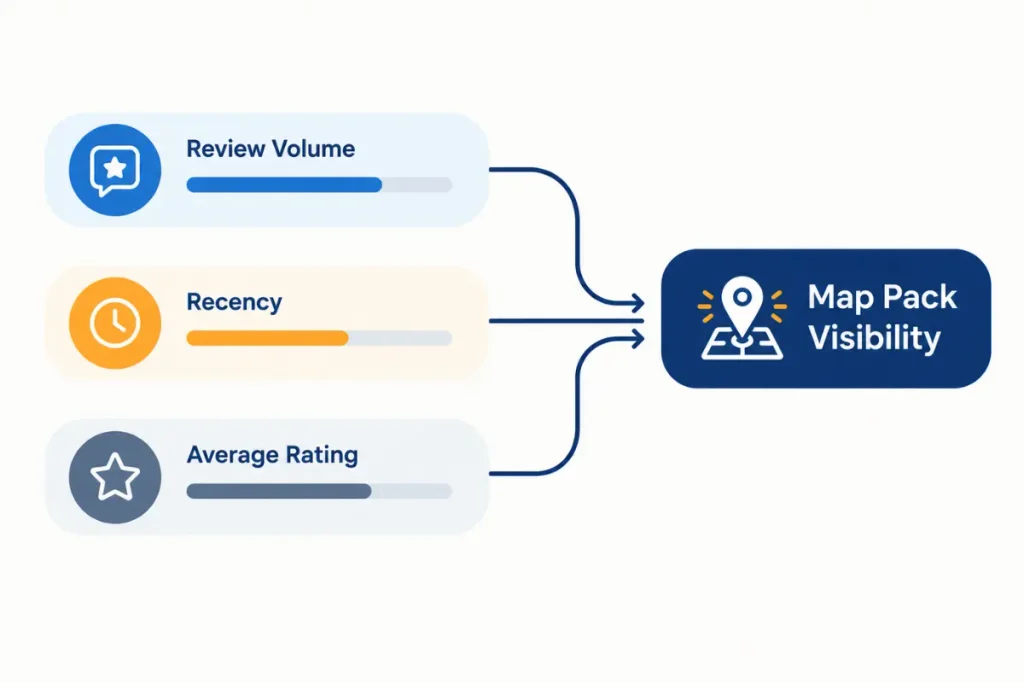
Google’s local algorithm considers review volume, recency, and average rating when ranking businesses in the Map Pack for searches such as “roofer near me” or “roof replacement near me.” Roofing companies with more recent and higher-rated reviews than competitors gain a significant advantage in local visibility, independent of technical SEO efforts on their website.
Reputation management is most effective when integrated into a comprehensive local SEO strategy. When combined with service-area pages, citation consistency, and Google Business Profile optimization, reputation becomes one of several key factors. For a detailed overview of this broader approach, see our guide to roofing SEO.
Common Reputation Management Mistakes Roofing Companies Make
Failing to respond to negative reviews can make you seem indifferent to future readers, not just the original reviewer.
Requesting reviews only after complaints, rather than after routine jobs, results in reactive feedback that is less balanced and representative.
Using identical, generic replies for every review can undermine your profile’s credibility.
Treating reputation management as a one-time effort, rather than an ongoing practice, does not build the same level of trust.
Failing to monitor platforms beyond Google, such as Yelp, Facebook, and Nextdoor, can influence homeowner decisions even if you do not actively check them.
Frequently Asked Questions
Want More Local Leads From Google?
A strong roofing reputation works best when supported by a local SEO strategy that connects your business with homeowners actively seeking roofing services. Dynamic Orbit Media integrates content creation, Google Business Profile optimization, and local SEO into a unified approach, helping improve your reputation and search rankings.