
100+ Roofing SEO Keywords: Service, Local, and Blog Keyword Lists
If you operate a roofing company and are seeking to determine which roofing SEO keywords are most appropriate for your website, you are not alone. Many online keyword lists present an overwhelming array of terms without guidance on their application. This guide offers a structured approach by categorizing roofing SEO keywords according to relevant page types, including service pages, location pages, blog content, and your Google Business Profile. This organization enables you to implement each keyword set effectively.
This guide is intended for roofing business owners, marketing managers, and individuals responsible for SEO in residential or commercial roofing companies who require a practical and organized keyword list rather than an unstructured compilation of terms. Whether you are developing a new website, updating an existing one, or seeking to understand customer search behavior, this resource provides a structured starting point.
Table of Contents
Why Keyword Strategy Matters for Roofing SEO
Roofing-related searches differ from most home service queries due to their frequent urgency. For example, a homeowner searching for “roof leak repair near me” during a storm is typically seeking immediate assistance rather than browsing options. Consequently, roofing SEO keywords can be categorized into several distinct intent layers: individuals ready to hire immediately, those comparing service providers, individuals experiencing an active emergency, and those seeking to understand a roofing issue before contacting a professional.
Accurately mapping roofing SEO keywords to appropriate website pages is more effective than compiling an extensive keyword list. Service pages overloaded with informational keywords typically exhibit low conversion rates, while blog posts targeting transactional queries such as “roof replacement cost [city]” often perform poorly compared to dedicated local service pages. The objective is not to utilize every keyword indiscriminately, but rather to assign keywords strategically so that the site structure aligns with user search behavior.
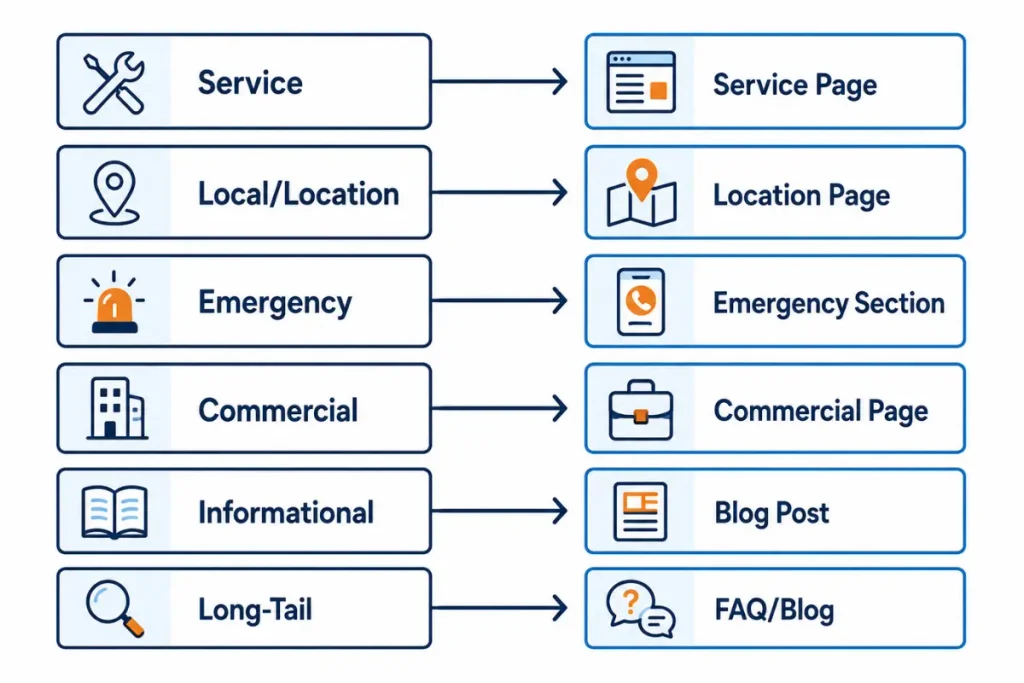
Types of Roofing SEO Keywords at a Glance
Before diving into the full lists, here’s a quick reference for how each keyword category typically maps to a page type on your site.
| Keyword Type | Typical Page Type | Example |
|---|---|---|
| Service keywords | Service pages | roof replacement |
| Local/location keywords | Location or service-area pages | roofing contractor in Austin |
| Emergency/urgency keywords | Emergency service page or service page section | emergency roof repair near me |
| Commercial keywords | Commercial roofing service page | commercial flat roof repair |
| Informational/blog keywords | Blog posts, FAQ content | how long does a roof last |
| Long-tail keywords | Blog posts, FAQ schema, voice search | why is my roof leaking after heavy rain |
Roofing Service Keywords
Service keywords define the specific offerings of a roofing company. These keywords form the basis of core service pages and should be included in page titles, H1 headings, and body content for each distinct service provided.
| Keyword | Example Use |
|---|---|
| roof repair | Core service page |
| roof replacement | Core service page |
| roof installation | Core service page |
| new roof installation | Core service page or blog |
| roof inspection | Service page or lead magnet offer |
| roofing contractor | Homepage, about page |
| residential roofing | Service page |
| commercial roofing | Service page |
| metal roofing | Service page (if offered) |
| shingle roof repair | Service page or blog |
| flat roof repair | Service page (if offered) |
| roof maintenance | Service page or blog |
| roof coating | Service page (if offered) |
| gutter installation | Add-on service page |
| storm damage roof repair | Service page |
Local and Location-Based Roofing Keywords
Roofing SEO is local by nature. Almost every homeowner searching for roofing services wants a company that serves their specific area, which is why location-based keywords deserve their own dedicated pages rather than being folded into generic service pages.
| Keyword Pattern | Example |
|---|---|
| roofing contractor in [city] | roofing contractor in Tampa |
| roof repair [city] | roof repair Denver |
| roof replacement [city] | roof replacement Phoenix |
| roofing company near me | roofing company near me |
| roofer near me | roofer near me |
| best roofing company in [city] | best roofing company in Charlotte |
| licensed roofer [city] | licensed roofer Columbus |
| roofing services [state] | roofing services Texas |
For organizations serving multiple cities or broader regions, it is advisable to create a dedicated location page for each service area instead of attempting to rank a single page for all cities. Each page should provide genuine, specific information about the respective service area, rather than merely substituting the city name.
Emergency and Urgency Roofing Keywords
This factor distinguishes roofing from many other local service industries. Storm damage, sudden leaks, and structural issues prompt consumers to search with significant urgency, and Google responds to these searches differently than to routine inquiries.
| Keyword | Example Use |
|---|---|
| emergency roof repair | Emergency service page or section |
| emergency roof repair near me | Emergency service page |
| 24 hour roofing repair | Emergency service page |
| storm damage roof repair | Service page |
| roof leak repair | Service page or blog |
| roof tarping service | Emergency service page |
| same day roof repair | Emergency service page |
| roof leak emergency | Emergency service page or blog |
Clearly indicate any emergency or same-day response services on pages targeting these keywords. Homeowners searching for these terms typically make decisions within minutes rather than days.
Commercial Roofing Keywords
Commercial roofing customers exhibit distinct search behaviors compared to residential homeowners. These customers are often facilities managers, property owners, or business owners who compare options over an extended period and typically use more specific technical language in their searches.
| Keyword | Example Use |
|---|---|
| commercial roofing contractor | Commercial service page |
| commercial roof repair | Commercial service page |
| commercial flat roof repair | Commercial service page |
| single ply membrane roofing | Commercial service page |
| industrial roofing contractor | Commercial service page |
| commercial roof replacement cost | Blog or pricing page |
| commercial roof inspection | Commercial service page |
When serving both residential and commercial clients, maintain separate pages for each audience. Combining them reduces the relevance for both groups and impedes accurate search engine matching.
Informational and Blog Keywords
These questions are typically posed by homeowners prior to engaging a service provider. Such queries generally face less competition than transactional keywords and serve as an effective means to establish topical authority and foster trust before a sale.
| Keyword | Example Use |
|---|---|
| how long does a roof last | Blog post |
| signs you need a new roof | Blog post |
| how much does a new roof cost | Blog post |
| how to tell if your roof is damaged | Blog post |
| how often should you replace your roof | Blog post |
| best roofing materials for [climate] | Blog post |
| roof warranty explained | Blog post |
| how to find a good roofing contractor | Blog post |
Each question should be answered comprehensively, with a link provided to the relevant service page after the reader’s informational needs are met. Implementing FAQ schema and prioritizing answer-first content is effective for optimizing visibility in AI Overviews and featured snippets.
Long-Tail Roofing Keywords
Long-tail keywords refer to extended, highly specific phrases that typically exhibit lower individual search volumes but demonstrate clearer user intent. These keywords are particularly valuable for voice search applications and for capturing the precise language homeowners employ when experiencing frustration or confusion.
| Keyword |
|---|
| why is my roof leaking after heavy rain |
| how do I know if my roof has storm damage |
| what to do if a shingle blows off my roof |
| how much does it cost to fix a small roof leak |
| do I need a permit to replace my roof |
| how to file a roof insurance claim |
| what is the best time of year to replace a roof |
These work well as standalone blog post titles or as FAQ entries nested inside a broader service or blog page.
How to Find More Roofing Keywords
The lists above cover the core categories, but every market has its own local quirks. A few practical ways to expand your list:
- Check your Google Business Profile insights. Google shows you the actual search terms people used to find your listing, which is one of the most reliable sources of real, local roofing keywords specific to your business.
- Use Google autocomplete. Start typing a roofing term into Google and note what it suggests. These are real queries other people are searching.
- Read the People Also Ask box. Search any core roofing keyword and open the “People Also Ask” questions for a steady stream of informational keyword ideas.
- Check your own call and form data. The exact phrases customers use when they call or fill out a form often reveal keyword language you haven’t targeted yet.
How to Use These Keywords on Your Website
Having the list is only half the work. Where you place each keyword matters as much as which keywords you choose.
- Service pages should target service keywords and, where relevant, a location keyword in the page title and H1 (for example, “Roof Replacement in Tampa, FL”).
- Location pages should target city or service-area keywords, with unique content about that specific area rather than a duplicated template with only the city name swapped.
- Blog posts should target informational and long-tail keywords, answering the question directly in the first few sentences before expanding further.
- Your Google Business Profile should reflect your core service keywords naturally in your business description and services list, since this feeds directly into local pack visibility.
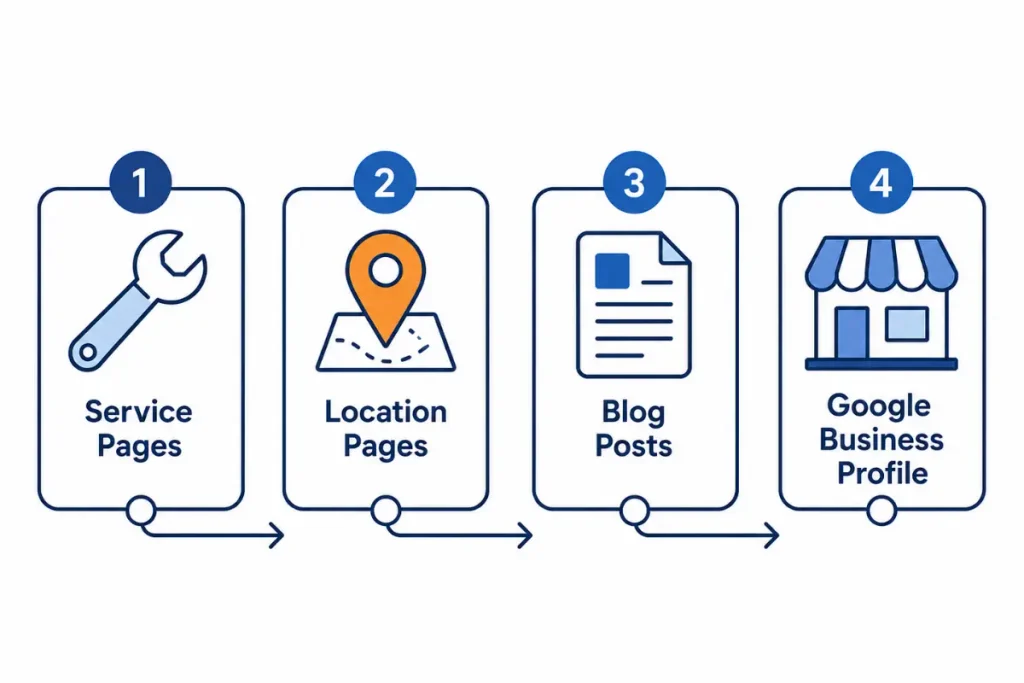
Attempting to optimize a single page for every keyword on a given list is a frequent error. Instead, clusters of related keywords should be assigned to dedicated pages, allowing each page to address a specific topic effectively.
Common Roofing SEO Keyword Mistakes to Avoid
- Targeting only high-volume keywords. A keyword with modest search volume but strong local intent often converts better than a broad, high-volume term with vague intent.
- Ignoring emergency and urgency keywords. These searches convert quickly, but only if your page clearly states you offer fast or same-day response.
- Duplicating location pages. Swapping out only the city name across otherwise identical pages tends to underperform and can create the kind of overlapping pages Google struggles to rank well.
- Mixing residential and commercial content on the same page. This dilutes relevance for both audiences.
- Keyword stuffing. Repeating a keyword unnaturally throughout a page reads poorly to visitors and doesn’t help rankings the way it once did.
Frequently Asked Questions
Want Help Turning These Keywords Into a Local SEO Strategy?
A keyword list serves as an initial foundation. Determining which roofing SEO keywords to target on each page and structuring the website accordingly often presents challenges for many roofing companies. For comprehensive guidance on developing a roofing SEO strategy using these keywords, Roofing SEO outlines Dynamic Orbit Media’s approach to enhancing local visibility, optimizing Google Business Profiles, and generating organic leads for roofing companies.