How to Rank My Roofing Website on Google: A Step-by-Step Guide
Many roofing professionals seeking guidance on ranking their websites on Google run into two common issues: oversimplified SEO checklists filled with buzzwords or overly technical explanations that lack actionable steps. While the core concepts of Google SEO for roofing companies are straightforward, effective implementation requires executing several specific actions in the right order and staying consistent.
This guide outlines which elements to address first, what to develop subsequently, and how to approach the process as a cohesive roofing company SEO strategy rather than a series of isolated tasks.
To improve a roofing website’s Google ranking, start by fully optimizing the Google Business Profile. Next, create dedicated pages for each primary service and every city you serve. Target keywords based on buyer intent, such as emergency, project-based, research-oriented, and local searches. Address fundamental technical issues, including site speed and mobile usability, and consistently acquire customer reviews and local backlinks. Ranking improvements generally occur over several months rather than days.
Table of Contents
Common Reasons Roofing Websites Fail to Achieve High Search Rankings
The roofing industry presents unique search engine optimisation challenges because demand varies widely. Search interest increases significantly following storms, declines during the coldest winter weeks in many regions, and peaks during insurance claim seasons in areas susceptible to hail or wind damage. Websites designed for consistent demand often fail when search volume spikes rapidly over a short period.
A common structural issue among roofing websites is relying on a single, generic “Services” page that tries to rank for multiple offerings, such as roof repair, roof replacement, storm damage, and commercial roofing. Search engines typically prioritize websites that provide dedicated pages for each specific service and geographic area. When the homepage must rank for all services, it can hurt overall search performance and push website owners to look for ways to improve their rankings.
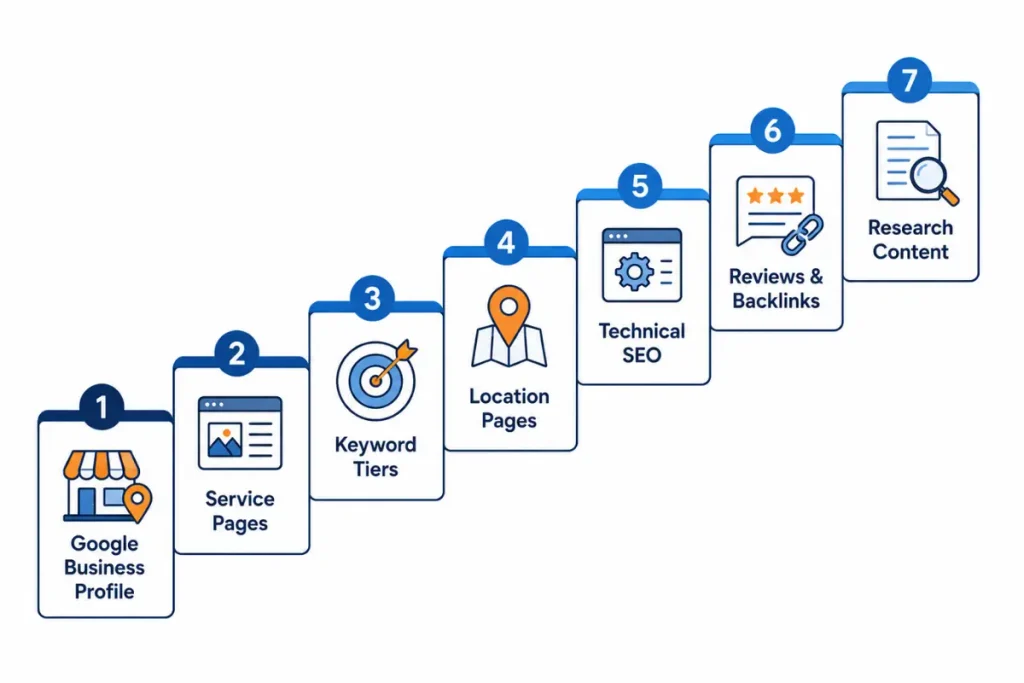
Step 1: Optimize the Google Business Profile
For many roofing companies, the Google Business Profile (GBP) contributes more significantly to search rankings than the website itself. The Local Map Pack, which displays three business listings above organic search results for local queries, attracts most clicks for searches such as “roofer near me” or “roof repair [city].” Homeowners comparing map listings on mobile devices seldom review the organic search results below.
To get this right:
- Set your primary category to the most accurate match (typically “Roofing Contractor,” not a generic “Contractor” category)
- List every service you actually offer, not just the ones you want to be known for
- Add real photos of completed jobs, your crew, and your vehicles, updated regularly
- Set your service area accurately. A service area that is too broad dilutes your relevance in every individual city inside it
- Keep your business name, address, and phone number (NAP) identical across your website, GBP, and every directory you appear in
When the website is well developed but the Google Business Profile (GBP) is incomplete, prioritize updating the GBP. This approach typically yields quicker results.
Related reading: Google Business Profile Optimization
Step 2: Create a Dedicated Webpage for Each Core Service
Roof replacement, roof repair, storm restoration, and commercial roofing represent distinct search intents and therefore require separate webpages. Consolidating all four services on a single “Services” page prevents Google from identifying a strong, relevant page to rank for each service individually.
Each service page should address common homeowner questions before initial contact, including an overview of the process, estimated timelines, factors influencing cost (without providing unguaranteed exact prices), and the service provider’s distinguishing approach. Display the phone number and a prominent call to action near the top of the page, especially for services that may attract emergency searches.
If you serve both residential and commercial customers, address these audiences on separate pages. Homeowners seeking leak repairs and property managers evaluating TPO versus EPDM roofing systems have distinct informational needs, and a unified page typically fails to meet either group’s requirements effectively.
Step 3: Prioritize Roofing Keywords According to Buyer Intent
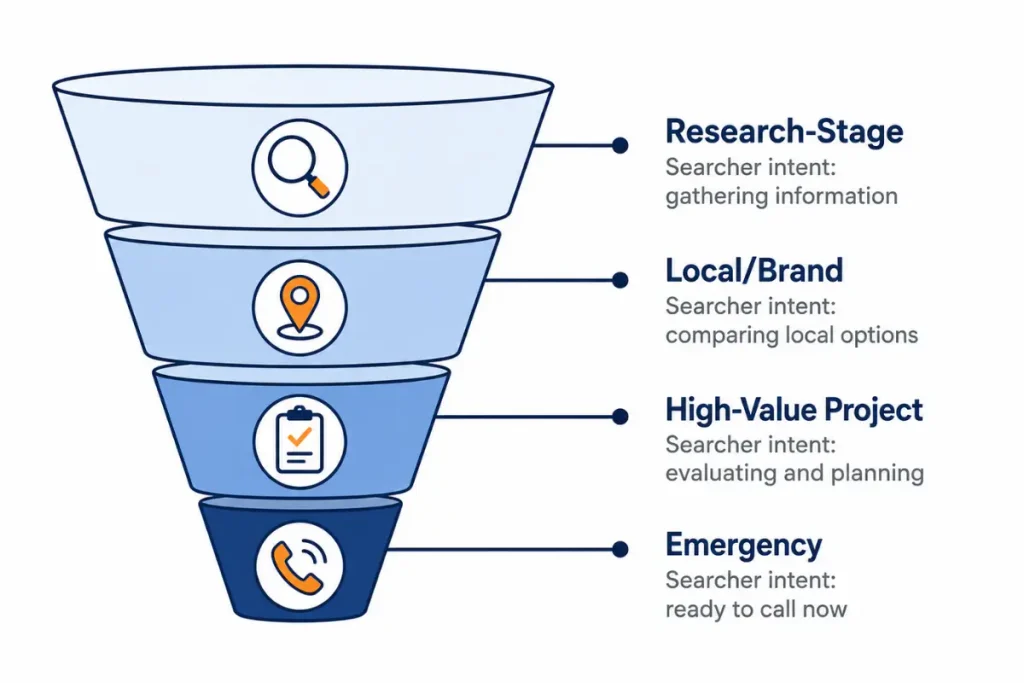
Roofing keywords vary in value, and equating terms like “roof replacement” with “how long do shingles last” is a common mistake. Categorise keywords into tiers based on how close the searcher is to making a hiring decision.
| Keyword Tier | Example Searches | Searcher Intent | Where It Should Live |
|---|---|---|---|
| Emergency | “roof leak repair now,” “emergency roof repair [city]” | Ready to call immediately | Dedicated emergency/service page, prominent phone number |
| High-value project | “roof replacement,” “metal roofing installation” | Comparing options, close to hiring | Core service pages |
| Research-stage | “how much does a new roof cost,” “asphalt vs metal roofing” | Gathering information, not ready yet | Blog or resource content |
| Local/brand | “[your company] reviews,” “roofers near me” | Checking credibility or nearby options | GBP, homepage, review pages |
Developing content that addresses all four tiers, rather than focusing only on those perceived as most “SEO-friendly,” keeps a roofing company’s SEO strategy effective year-round, not just during storm season.
Step 4: Develop a Dedicated Page for Each City or Neighborhood Served
For businesses serving multiple towns or regions, a single “About Us” or “Service Area” paragraph is insufficient. Search engines require clear indicators of service in each area, typically achieved by creating a dedicated page for each city or major neighbourhood. Each page should feature unique, locally relevant content rather than duplicating text with only the city name changed.
However, avoid generating low-quality pages for infrequently served locations solely to increase page count. A limited number of comprehensive, locally relevant pages is more effective than numerous near-duplicate pages with repetitive content.
Related reading: Local SEO for Home Service Businesses
Step 5: Address Core Technical SEO Elements
For roofing businesses, technical SEO prioritises preventing lead loss from slow or inefficient websites over advanced techniques. A significant share of roofing-related searches, especially for emergency services, happen on mobile devices. If a website takes several seconds to load or makes a phone number hard to access, potential clients may leave before viewing the company’s portfolio.
Priorities worth checking:
- Page load speed on mobile, not just desktop
- A clean site structure so Google (and visitors) can find service and location pages easily
- Working, tappable click-to-call buttons on every page, especially service and location pages
- An updated XML sitemap so new pages get indexed promptly
- No broken links or duplicate pages competing against each other
None of this is glamorous, but a technically broken site undermines every other step on this list.
Step 6: Acquire Customer Reviews and Local Backlinks
Potential clients often review review counts and ratings before making contact. Google also considers review volume and recency as important local ranking factors. Establishing a consistent process for soliciting feedback from satisfied customers after each completed project is more effective than relying on a single, large-scale request.
Backlinks are also significant; however, for a roofing company, a limited number of relevant local links, such as those from trade associations, local news outlets, chamber of commerce listings, or supplier partnerships, typically provide greater local ranking benefits than a large quantity of generic or purchased links from unrelated websites.
Step 7: Develop Content Targeting the Research Stage in Addition to Emergency Situations
Although emergency searches often convert quickly, they are highly competitive and heavily influenced by weather conditions. Developing content that addresses research-stage questions—such as roof lifespan by material, indicators of storm damage, insurance claim processes, and comparisons between repair and replacement—improves visibility during periods of lower demand. This approach also adds topical depth, strengthening related service pages.
Answer engine optimization (AEO) is particularly important in this context. Homeowners increasingly get information from sources such as Google’s AI Overviews or tools like ChatGPT before engaging with websites. Providing clear, direct answers to specific questions, rather than relying on general marketing language, increases the likelihood that content will appear in AI-generated responses.
How Long Does It Take to Rank a Roofing Website on Google?
Most roofing companies observe initial improvements in local search rankings within one to three months after addressing technical issues and optimizing their Google Business Profile. Substantial organic growth for competitive keywords generally takes four to six months or more. In highly competitive markets or for websites with significant pre-existing issues, the process may take longer.
Use caution with claims of achieving first-page rankings within weeks for competitive keywords in saturated markets. Search engine optimization is a cumulative process. The first one to two months typically focus on foundational tasks, such as resolving Google Business Profile issues, addressing technical problems, and developing service and location pages. Noticeable ranking improvements generally occur only after these foundational elements are in place.
Sustaining Roofing Company SEO Performance Throughout the Off-Season
A common error among roofing companies is approaching search engine optimization (SEO) reactively, increasing efforts only after severe weather events. When demand surges, it is often too late to build the local signals Google prioritizes, such as a complete Google Business Profile (GBP), strong customer reviews, and well-developed service pages. These elements must be in place before demand spikes, not built in response.
An effective year-round SEO strategy for roofing companies typically integrates three core components: ongoing local visibility efforts such as Google Business Profile maintenance, review generation, and citation consistency; accurate and comprehensive service and location pages; and research-oriented content that maintains site relevance during slower periods. Viewing these activities as a continuous system, rather than a one-time project, distinguishes consistently high-ranking roofing websites from those whose visibility fluctuates with seasonal demand.
Frequently Asked Questions
Strategies to Increase Roofing Leads Through Google
Achieving high rankings for a roofing website on Google requires a comprehensive approach, including a fully optimised Google Business Profile, dedicated service and location pages, intent-driven keyword targeting, technical site integrity, and ongoing review and content generation. Many roofing companies struggle to implement these elements consistently, especially technical maintenance and content production. For organizations seeking professional support, Dynamic Orbit Media specialises in Google Business Profile optimization, local SEO, and enhancing Map Pack visibility for roofing businesses.
Explore Dynamic Orbit Media’s Roofing SEO services