Local SEO for Locksmith Businesses: Rank Higher, Get More Calls
When someone is locked out of their car late at night or breaks a key in their front door, they rarely look beyond the first page of Google. Instead, they select the most trustworthy result in the map pack and call immediately. This urgent, mobile-driven decision is the core challenge of local SEO for locksmith businesses.
Ranking in this space differs from ranking a blog or e-commerce site. Locksmiths operate in one of Google’s most closely monitored local categories, competing with legitimate businesses, call-center lead resellers, and fake listings. Success requires more than keyword optimization; you must demonstrate to both Google and customers that you are a legitimate, licensed business that reliably fulfills service requests.
This guide covers all essential strategies for 2026, including Google Business Profile optimization, site structure, keyword research, trust signals, citations, review generation, content, technical SEO, conversion rate optimization, and appearing in AI-generated answers. By the end, you will have a practical, prioritized playbook with a 90-day rollout plan to make local search your most reliable source of booked jobs and ensure your locksmith website ranks sustainably on Google.
Table of Contents
Why Local SEO Is Different (and Harder) for Locksmiths
While most local service businesses address planned purchases, locksmiths respond to urgent situations. This distinction affects every aspect of local SEO strategy, from targeted keywords to how Google evaluates listings.
High-Intent, Emergency-Driven Searches
Many locksmith searches occur at the moment of need rather than during advance research. For example, a person searching for a locksmith at 2 a.m. is unlikely to compare multiple companies. Instead, they will contact the provider who appears credible and available immediately.
This urgency has both advantages and challenges. Conversion rates are high due to strong intent, but users make quick decisions with limited information. As a result, your Google Business Profile, reviews, and map pack position are often more important than website content. If your business is not visible during this brief decision window, the opportunity is lost.
Emergency-driven demand requires your SEO to address irregular, after-hours needs. Content and profile elements that highlight 24/7 availability, rapid response, and immediate dispatch are more effective than generic service descriptions.
Why Google Treats Locksmiths as a High-Risk Category
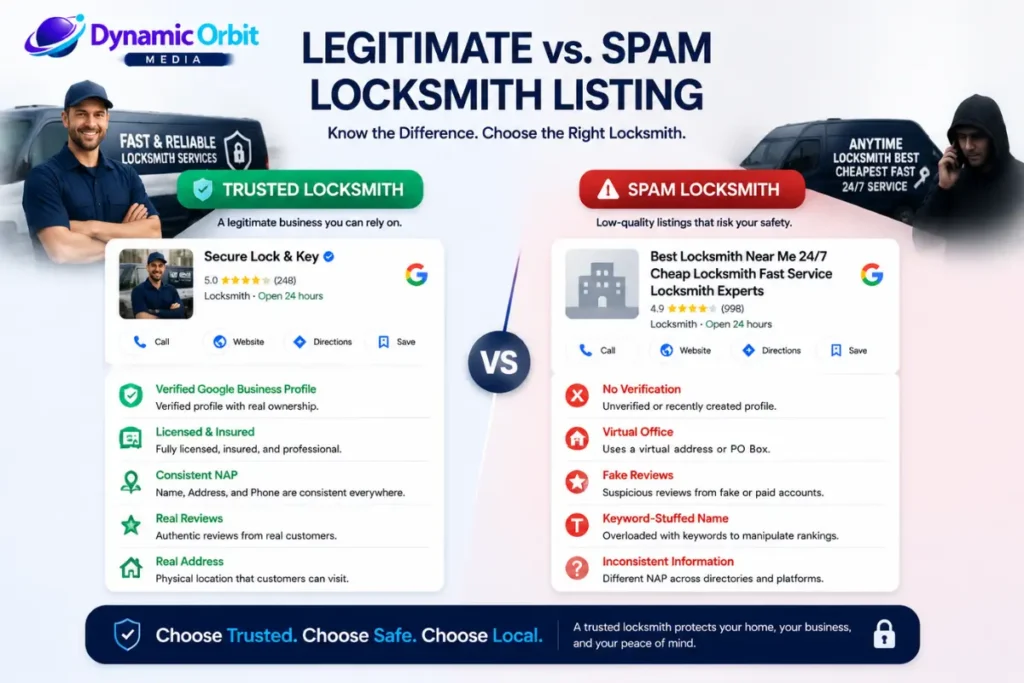
Locksmith search has a well-documented history of abuse. For years, lead-generation call centers created fake storefronts and virtual office listings, used keyword-heavy business names, and directed emergency calls to subcontracted, often unlicensed technicians who charged inflated prices. In response, Google classified locksmiths, along with garage door repair, plumbing, and towing, as a “sensitive” or high-risk category.
In practice, that means:
- Stricter enforcement of Google Business Profile guidelines, including address and service-area verification
- More aggressive suspension of listings that show spam signals (duplicate businesses, virtual offices, inconsistent NAP data)
- Greater weight placed on trust and legitimacy signals — real reviews, licensing, consistent citations — rather than raw keyword optimization
- Periodic “suspension waves” that can wipe out large numbers of listings that don’t meet current verification standards
In summary, locksmiths who focus on establishing legitimacy through local SEO, rather than relying on keyword-stuffing, are more likely to maintain their rankings during Google’s periodic reviews.
The Real Cost of Losing a Ranking Position
Local SEO for locksmiths is essential and directly impacts revenue. A single lockout or lock-change job typically generates between $75 and $250, while larger commercial or automotive jobs can yield significantly more.
If your business falls from the top three positions in the map pack to fifth or sixth, you risk losing most of your traffic. Studies consistently show that the top three map results receive the majority of clicks and calls, while visibility declines significantly beyond these spots. For a locksmith, even a few missed jobs each week due to lower rankings can result in thousands of dollars in lost revenue each month.
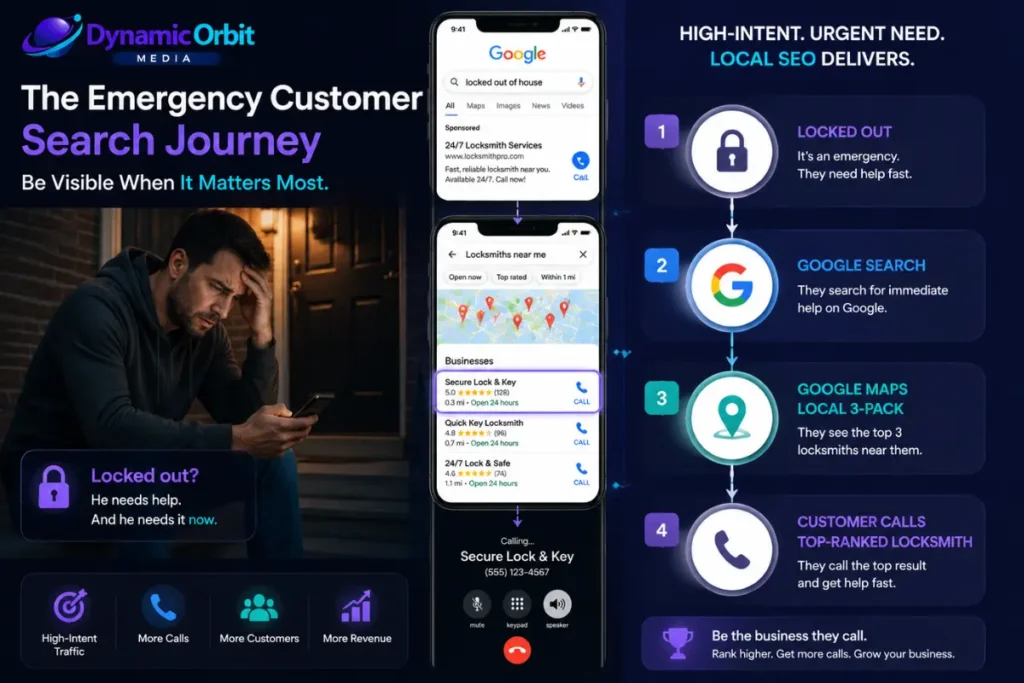
For budgeting purposes, consider this: if your average job value is $150 and you lose 10 calls per month by dropping out of the map pack’s top three, that results in over $1,500 in lost monthly revenue. This amount often exceeds the cost of effective local SEO.
Laying the Foundation: Google Business Profile & the Map Pack
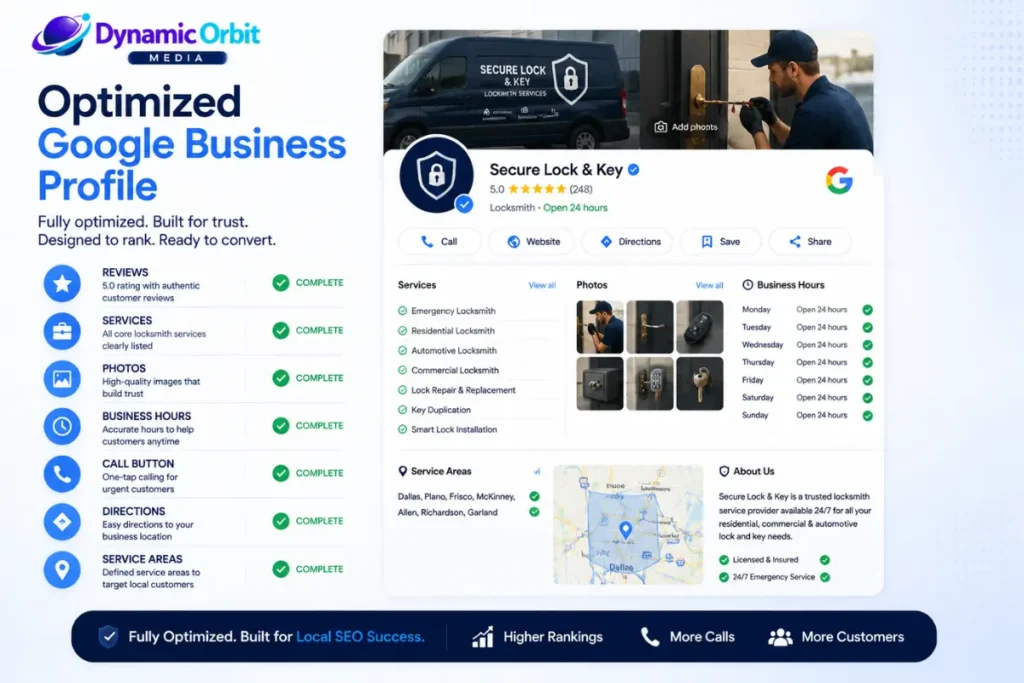
For most locksmiths, the Google Business Profile (GBP) generates more calls than the website. It is the first result searchers see, the main factor in map pack rankings, and the aspect of your online presence Google reviews most closely.
Claiming and Verifying Your Profile (Including the Video-Verification Checklist)
Due to frequent abuse in this category, Google often requires locksmiths to complete video verification instead of the standard postcard or phone methods. During verification, a Google reviewer will ask you to film your storefront, signage, work vehicles, equipment, and sometimes your team performing a job in real time.
Before starting verification, ensure you have the following prepared:
- Business signage: Exterior signage with your business name clearly visible and matching your GBP listing exactly.
- Interior or workspace footage: A shop, office, or dispatch area that demonstrates your business is actively operating.
- Vehicles and equipment: Branded vehicles, tool kits, key-cutting machines, or lock hardware relevant to your services
- Proof of location: Visible street signs or landmarks that confirm your filmed location matches your listed address.
- Team presence: A technician or staff member on camera, ideally introduced briefly by name and role during the walkthrough.
- Licensing documentation: Some reviewers may request to see your license number or certificate during the call.
Skipping steps or rushing the video is a common reason for locksmith profile rejections. Approach verification with the same attention as a licensing inspection, as it serves a similar purpose.
Choosing Categories, Services, and Service Areas
Your primary GBP category should be the most accurate match for your core business — typically “Locksmith,” with more specific categories (such as “Auto Locksmith” or “Commercial Locksmith”) added as secondary categories if they genuinely apply. Avoid piling on categories that don’t reflect real services; Google increasingly treats category stuffing as a spam signal.
Inside the “Services” section, list every discrete offering rather than lumping everything into one vague line:
- Emergency lockout (residential, commercial, automotive)
- Lock rekey and lock change
- Key duplication and key cutting
- Broken key extraction
- Transponder and fob programming
- High-security lock installation
- Commercial master key systems
- Safe opening and installation
For service areas, define the specific cities or zip codes you genuinely serve — not a sprawling regional radius. Google increasingly cross-checks service-area claims against your actual review geography and citation data, and overreaching here is a common trigger for suspension.
Photos, Posts, and Q&A That Build Trust
Profiles featuring recent, authentic photos consistently perform better than those using stock images. Upload photos of your team, vehicles, storefront, and, when appropriate, before-and-after shots of completed jobs with customer permission.
Consistent use of Google Posts signals an active, well-maintained profile and provides an additional opportunity to highlight service keywords and promotions. Share updates related to seasonal demand, such as holiday lockouts, storm season, or moving season, to remain relevant.
Please note for 2026: Google has removed the public Q&A feature from Business Profiles. If your current materials reference building a Q&A section on your GBP, that guidance is now outdated. Redirect these efforts to your website’s FAQ content and Google Posts, where they continue to provide SEO value.
Google Local Services Ads and the “Google Guaranteed” Badge
Google Local Services Ads (LSAs) appear above both organic results and the map pack, making them highly visible for locksmiths. To use LSAs, you must usually complete a background check and licensing verification. Qualifying businesses then receive the Google Guaranteed badge, shown as a green checkmark, which indicates Google has vetted the business and offers a satisfaction guarantee up to a specified amount.
In a high-trust-deficit field like locksmithing, this badge is especially valuable. It directly addresses concerns about legitimacy that many emergency searchers have. Pursue this badge in addition to, not in place of, organic local SEO.
Site Structure That Search Engines and AI Understand
Your website’s structure communicates your services and locations to Google and AI systems. A single, generic services page creates confusion for both search engines and customers.
Service Pages vs. a Generic “Locksmith Services” Page
A single page listing “lockouts, rekeys, key cutting, and commercial locks” cannot compete with dedicated pages focused on each service. Search engines favor specific content that matches user intent. For example, someone searching for “car key fob programming” expects a detailed page on that topic, not just a brief mention.
At minimum, most locksmith sites benefit from standalone pages for:
- Emergency lockout services
- Residential lock rekey and installation
- Automotive locksmith and key fob services
- Commercial locksmith and master key systems
- Smart lock installation and upgrades; safe services (if offered)
Each page should address key questions for searchers: cost, response time, what is included, and your qualifications. Avoid repeating generic marketing language on every page.
Location and Service-Area Pages: Single-Location vs. Multi-Location Structure
How you structure location pages depends heavily on your footprint:
| Business Type | Recommended Structure | Example |
|---|---|---|
| Single location, single city | One strong homepage + service pages; no separate “city” pages needed | Homepage optimized for “[City] locksmith” |
| Single location, multiple nearby cities served | Dedicated service-area pages for each city/suburb you legitimately serve | /locksmith-austin/, /locksmith-round-rock/ |
| Multiple physical locations | Individual location pages per branch, each with unique NAP, hours, and localized content | /locations/dallas/, /locations/fort-worth/ |
| Franchise or multi-location enterprise | Location pages nested under service pages, or vice versa, to scale combinations without duplicate content | /dallas/emergency-lockout/, /dallas/car-key-replacement/ |
Larger multi-location operators often create service and location-specific pages to capture long-tail local search traffic. This approach is effective only when each page offers unique, locally relevant content. Thin, templated pages that simply change the city name are known to cause quality issues instead of improving rankings.
Internal Linking Between Services, Locations, and Blog Content
Internal links clarify page relationships for Google and guide users from informational content to booking. Consider these practical approaches:
- Link blog content, such as “What to Do If You’re Locked Out of Your Car,” directly to the relevant service page.
- Link each location page to the specific services offered at that location.
- Ensure your homepage prominently links to your most valuable service and location pages, rather than only using a generic “Services” dropdown.
- Use descriptive anchor text, such as “emergency locksmith in [city],” instead of generic “click here” links.
Keyword Research for Locksmiths
Effective locksmith keyword research requires more than analyzing search volume. It involves aligning keywords with user intent and urgency, as service, location, and emergency terms each address distinct needs and face varying competition depending on market size. The most successful pages and GBP content incorporate all three elements. For example, a search such as “emergency locksmith near me” reflects both urgency and location intent.
Read our full guide to SEO keywords for locksmiths →
Gauging Keyword Difficulty in Your Local Market
Keyword difficulty scores from tools like Ahrefs or SEMrush reflect national competition and often do not accurately represent how challenging it is to rank for a term in your local market. A term considered “high difficulty” nationally may have little competition in a mid-sized city with only a few established competitors.
A more reliable approach:
- Search the term yourself, from a location matching your service area (or use a rank tracker with local grid data)
- Count how many genuinely local, well-established competitors occupy the map pack and top organic results
- Check whether top-ranking pages are thin, generic, or clearly under-optimized — a sign of real opportunity
- Prioritize terms where local competition is weak, even if national volume looks modest
For most locksmiths, a handful of well-optimized, high-intent local terms will outperform a long list of loosely targeted national keywords.
Building Trust Signals That Convert Emergency Searchers
Trust is not a secondary metric in locksmith SEO. It is often the most important factor for ranking and conversion, as Google has implemented anti-spam systems for this category and customers are naturally cautious.
Displaying Licensing, Bonding, and Insurance
If your state or municipality requires locksmith licensing, display your license number prominently in your website footer, on service pages, and in your GBP description where possible. Including bonding and insurance details reassures both customers and Google that you are accountable for your work.
This is especially important because many unlicensed operators work in this field. Displaying your license number provides a clear and credible point of differentiation.
Collecting Detailed, Service-Specific Reviews
Generic five-star reviews, such as “great service, fast!”, are helpful, but reviews that mention specific services, locations, and outcomes provide greater SEO and trust value. For example, a review stating “rekeyed our front door lock in Round Rock in under 30 minutes on a Sunday” reinforces service keywords, location relevance, and responsiveness.
Request reviews from satisfied customers promptly after completing the job, while their positive experience is still fresh. Make the process easy; sending a direct link via text message is often more effective than a generic email request.
Real Photos, Case Studies, and Team Bios
Stock photos of unidentified locksmiths raise concerns among discerning customers and do not contribute to EEAT (Experience, Expertise, Authoritativeness, Trustworthiness) signals for search engines. Using real photos of your team, vehicles, and completed jobs, along with brief bios highlighting technician experience and certifications, helps distinguish your business as legitimate.
Transparent Pricing to Reduce Buyer Anxiety
Locksmith pricing scams, where customers receive one quote by phone but are charged significantly more on-site, are common. As a result, concerns about hidden fees are widespread. Publishing clear starting prices or price ranges for common services, such as lockout, rekey, and key duplication, reduces customer hesitation and demonstrates transparency. This approach can increase conversion rates and decrease the number of visitors who leave due to concerns about legitimacy.
How to Signal You’re Not One of the Spam Listings
Because Google actively hunts for spam signals in this category, it helps to consciously build the opposite pattern into every part of your online presence:
- One GBP listing per real physical or verified service-area location — never duplicates
- Consistent business name across your website, GBP, and all directories (no keyword-stuffed name variants like “Fast 24 Hour Locksmith Austin TX”)
- A real, staffed address — not a UPS box, coworking space, or vacant lot
- Phone number that’s answered by your actual dispatch, not routed to a third-party call center
- Reviews that arrive at a natural, gradual pace rather than in suspicious bursts
NAP Consistency and Citation Building
NAP stands for Name, Address, and Phone number. Consistent NAP information across the web is a key local SEO factor. This is particularly important for locksmiths, as Google closely reviews this category for duplicate or fraudulent listings.
Core Directories: Google, Yelp, Angi, BBB, Bing Places, Apple Maps
At minimum, claim and fully optimize your listings on:
- Google Business Profile
- Yelp
- Angi (formerly Angie’s List)
- Better Business Bureau (BBB)
- Bing Places
- Apple Maps (via Apple Business Connect)
Ensure every listing uses the exact business name, address format, and phone number as your GBP. Even minor inconsistencies, such as abbreviations or alternate phone numbers, can weaken the trust these citations are intended to establish.
Trade-Association Credibility: ALOA and Local Licensing Boards
Membership in the Associated Locksmiths of America (ALOA) or a state or local locksmith licensing board serves as a strong, credible trust signal. When these organizations provide public member directories, being listed acts as both a citation and a mark of legitimacy that lead-generation operators usually cannot duplicate.
Displaying association logos and license numbers on your website, along with a link to the verifying directory when possible, further strengthens your credibility for both visitors and search engines assessing your EEAT signals.
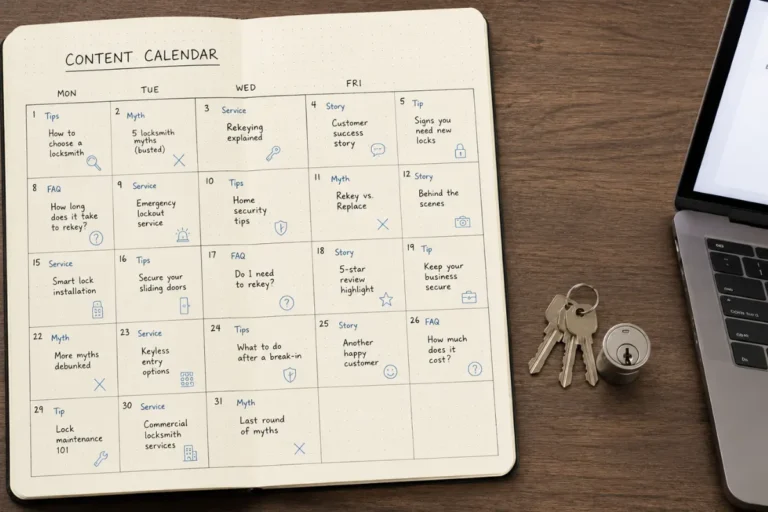
Content and Local Link Building
In addition to service and location pages, regularly updated content allows you to target informational searches, establish topical authority, and earn backlinks that sustain long-term rankings.
Blog Topics That Answer Real Customer Emergencies
High-performing locksmith content often addresses the urgent questions customers search during emergencies:
- “What to Do If You Lock Your Keys in Your Car”
- “How Much Does It Cost to Rekey a House?”
- “Broken Key in the Lock? Here’s What Not to Do”
- “Car Key Fob Not Working — Troubleshooting Before You Call a Locksmith”
- “How to Tell If Your Locks Need to Be Changed After a Break-In”
These topics serve two purposes: they attract top-of-funnel informational search traffic and, when internally linked to relevant service pages, guide visitors toward booking.
Earning Backlinks Through Local Press, Sponsorships, and Trade Associations
Many locksmiths miss valuable link-building opportunities that are readily available.
- Local news coverage (home security tips, seasonal lockout trends, break-in prevention stories)
- Sponsoring local youth sports teams, community events, or neighborhood associations
- Chamber of Commerce membership and directory listings
- Guest contributions to local real estate or home-improvement blogs on security topics
- ALOA and licensing board directories, which often include a link back to your site
Since locksmiths serve local markets, hyper-local backlinks, such as those from city newspapers, neighborhood associations, or local realtor blogs, offer greater relevance and can significantly improve your site’s authority score compared to generic, unrelated links.
Technical SEO Essentials
Trust and quality content are not enough if your website is slow, not mobile-friendly, or technically inaccessible to search engines.
Mobile Speed and Core Web Vitals
Since most locksmith traffic comes from mobile searches during emergencies, page speed is critical for conversions. Visitors in urgent situations will not wait for slow-loading pages and will quickly move to a competitor.
Focus on:
- Building and maintaining a fully mobile-friendly website, since most locksmith searches happen on a phone
- Compress and properly size images, which are often a source of slow load times on locksmith websites.
- Minimize render-blocking scripts, particularly third-party chat widgets and tracking pixels.
- Ensure Core Web Vitals, including Largest Contentful Paint, Interaction to Next Paint, and Cumulative Layout Shift, meet Google’s “Good” thresholds.
- Make your phone number a tap-to-call link that is immediately visible on mobile devices without scrolling.
Schema Markup for Local Business and Emergency Services (With a Sample Snippet)
Structured data enables Google and AI search systems to clearly identify your business details, such as name, address, hours, service area, and offerings, instead of relying solely on page text.
A basic LocalBusiness schema for a locksmith should include your NAP data, hours (noting any true 24/7 availability), service area, and a list of services offered:
{
“@context”: “https://schema.org”,
“@type”: “Locksmith”,
“name”: “Example Locksmith Co.”,
“image”: “https://www.examplelocksmith.com/logo.jpg”,
“telephone”: “+1-555-123-4567”,
“address”: {
“@type”: “PostalAddress”,
“streetAddress”: “123 Main St”,
“addressLocality”: “Austin”,
“addressRegion”: “TX”,
“postalCode”: “78701”,
“addressCountry”: “US”
},
“areaServed”: [
{ “@type”: “City”, “name”: “Austin” },
{ “@type”: “City”, “name”: “Round Rock” }
],
“openingHoursSpecification”: {
“@type”: “OpeningHoursSpecification”,
“dayOfWeek”: [
“Monday”,”Tuesday”,”Wednesday”,”Thursday”,”Friday”,”Saturday”,”Sunday”
],
“opens”: “00:00”,
“closes”: “23:59”
},
“hasOfferCatalog”: {
“@type”: “OfferCatalog”,
“name”: “Locksmith Services”,
“itemListElement”: [
{ “@type”: “Offer”, “itemOffered”: { “@type”: “Service”, “name”: “Emergency Lockout Service” } },
{ “@type”: “Offer”, “itemOffered”: { “@type”: “Service”, “name”: “Lock Rekey” } },
{ “@type”: “Offer”, “itemOffered”: { “@type”: “Service”, “name”: “Automotive Key Programming” } }
]
},
“aggregateRating”: {
“@type”: “AggregateRating”,
“ratingValue”: “4.9”,
“reviewCount”: “213”
}
}
Only mark up a 24/7 openingHoursSpecification if you genuinely dispatch technicians around the clock — falsely claiming round-the-clock availability is both a trust risk with customers and a policy violation risk with Google.
Optimizing for AI Search and Answer Engines (GEO/AEO)
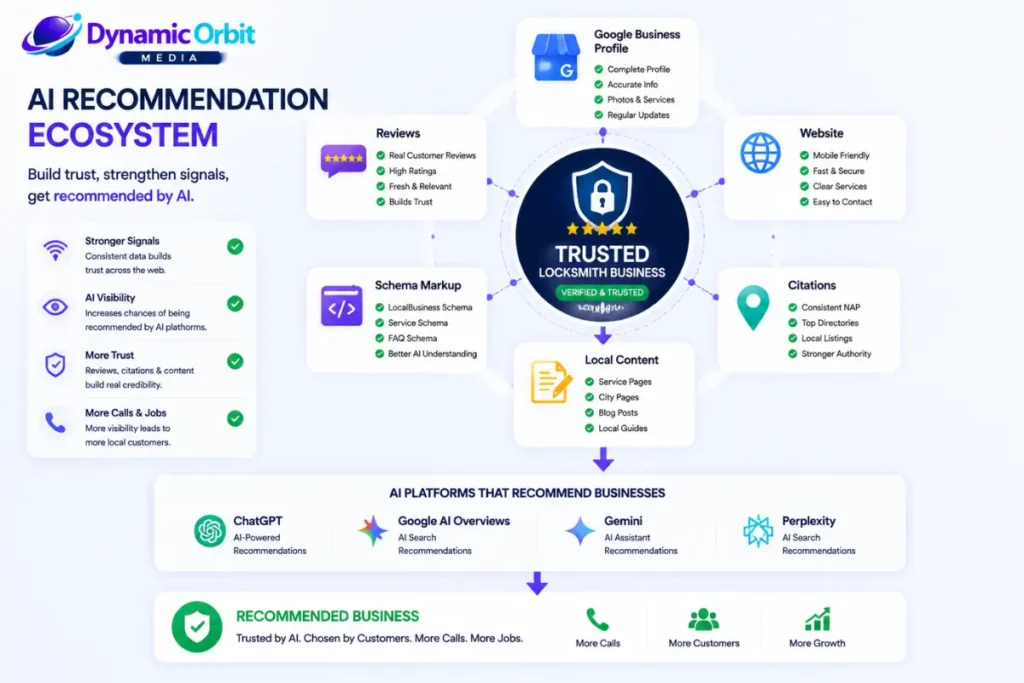
Search behavior now extends beyond traditional results pages. AI Overviews, ChatGPT, Gemini, Perplexity, and voice assistants often answer queries such as “who’s a good locksmith near me” directly, sometimes without users visiting a website. Generative Engine Optimization (GEO) and Answer Engine Optimization (AEO) help secure your business’s inclusion in these AI-generated answers.
How AI Tools Choose Which Locksmith to Recommend
AI systems favor businesses with clear, well-structured, and verifiable information, rather than those with only visually appealing websites. In practice, this means:
- Consistent NAP and service information across your website, GBP, and citations (AI systems cross-reference multiple sources)
- Provide clear, specific statements about your services, service areas, and availability, instead of relying on vague marketing language.
- Maintain a high volume of positive reviews and strong ratings, as AI recommendation engines place significant emphasis on reputation signals.
- Implement structured data (schema markup) to ensure your business information is machine-readable, rather than hidden within general text.
Structuring Content and Schema for AI Visibility
To ensure AI systems can easily extract and reference your content:
- Answer common questions directly and concisely at the top of the relevant page, before providing additional details. This is a “direct-answer-first” approach that aligns with how featured snippets and AI Overviews select content.
- Use clear headings that reflect actual user questions, such as “How much does it cost to rekey a house?” instead of “Our Pricing Philosophy.”
- Ensure all factual claims, including pricing, response times, and service areas, are explicit and consistent across all platforms.
- Maintain complete and accurate schema markup, as structured data is a key signal AI crawlers use to extract business information.
Tracking AI Visibility Alongside Traditional Rankings
Traditional rank tracking no longer provides a complete picture. Periodically review how your business appears in AI Overviews, ChatGPT, Gemini, and Perplexity using realistic customer prompts such as “who’s a reliable emergency locksmith in [city].” Some SEO platforms now offer dedicated AI-visibility tracking, but even manual spot-checks are preferable to overlooking this channel.
SEO vs. PPC vs. Local Service Ads: Choosing Where to Invest
None of these channels is strictly better. Each addresses different needs and timelines, and most established locksmiths eventually use a combination of all three.
| Channel | Speed to Results | Typical Cost Pattern | Best For |
|---|---|---|---|
| Organic Local SEO | Slow (3–6+ months to build) | Lower ongoing cost once established; requires upfront investment | Long-term, compounding lead flow; highest ROI over time |
| Google Local Service Ads | Fast (days to weeks) | Pay-per-lead, cost varies by market and competition | Immediate visibility, “Google Guaranteed” trust badge, verified leads |
| PPC (Search Ads) | Fast (immediate) | Pay-per-click, can be expensive in competitive locksmith markets | Filling gaps while SEO builds, promoting specific offers |
For most locksmiths, we recommend using Local Services Ads (LSAs) and pay-per-click (PPC) campaigns to generate leads immediately, while building your local SEO foundation through Google Business Profile, site structure, citations, and reviews. As your organic rankings improve over time, you can reduce paid advertising and rely more on SEO to deliver leads at a lower cost per job.
Measuring What Matters: Tracking Local SEO Performance
Without consistent measurement, you cannot determine if your local SEO investment is effective or which tactics are delivering results.
Key Metrics to Watch Monthly
- Map pack rankings for your priority service + location keyword combinations, tracked from multiple points in your service area (not just your office address)
- GBP insights: calls, direction requests, and website clicks originating from your profile
- Organic traffic and conversions to service pages, segmented by page
- Review velocity and average rating, tracked over time rather than as a single snapshot
- Call tracking data, ideally segmented by source (organic, GBP, LSA, PPC) so you know which channel is actually producing booked jobs
Tools for Rankings, Technical Health, and AI Visibility
A reasonably lean, effective toolkit includes:
- A local rank tracker with grid/heatmap capability (to see how rankings vary across your service area, not just at one point)
- Google Search Console and Google Business Profile Insights (free, and essential)
- A technical SEO crawler for Core Web Vitals and site health monitoring
- Call tracking software tied to your GBP and website numbers
- An emerging AI-visibility tool, or a manual monthly check across major AI assistants
A 90-Day Locksmith Local SEO Rollout Plan
For locksmiths starting from scratch — or cleaning up a neglected profile — here’s a realistic sequence for the first three months.
Days 1–30: Foundation
- Audit and correct NAP consistency across the website, GBP, and top directories
- Complete or reclaim GBP verification, including video verification if required
- Optimize GBP categories, services, service areas, and description
- Build or restructure core service pages (no more generic catch-all page)
- Implement baseline LocalBusiness/Locksmith schema markup
Days 31–60: Trust and Visibility
- Implement a structured review-request process for each completed job.
- Add licensing, bonding, and insurance information throughout the website and Google Business Profile.
- Develop location or service-area pages that reflect your operational footprint.
- Publish three to five emergency-focused blog posts, ensuring they are internally linked to relevant service pages.
- Claim and optimize any remaining core citations, including Yelp, Angi, BBB, Bing Places, and Apple Maps.
Days 61–90: Authority and Optimization
- Pursue ALOA or licensing-board directory listings and seek local sponsorship or press opportunities.
- Audit Core Web Vitals and mobile speed; resolve any critical issues.
- Expand schema markup to include individual services and offer catalogs.
- Track AI visibility in addition to traditional rank tracking.
- Review 90 days of ranking, call, and conversion data, and set priorities for the next quarter.
Last Thoughts
Local SEO for locksmiths centers on one principle: demonstrate your legitimacy clearly and unmistakably. Google’s increased scrutiny is not an obstacle to avoid but a filter that rewards businesses that establish legitimacy through full profile verification, transparent pricing, and authentic, service-specific reviews.
Start with the foundation — begin with the essentials: a verified profile, organized site structure, and consistent citations. Then add trust signals, strong technical performance, and content that addresses the urgent questions your customers are searching. This foundation increasingly influences recommendations from both traditional search engines and AI tools, so your efforts now will have lasting impact.s playbook into a prioritized action plan for your specific market, that’s exactly the kind of roadmap worth building next.