AI SEO for Garage Door Companies: Proven Ways to Win AI Visibility
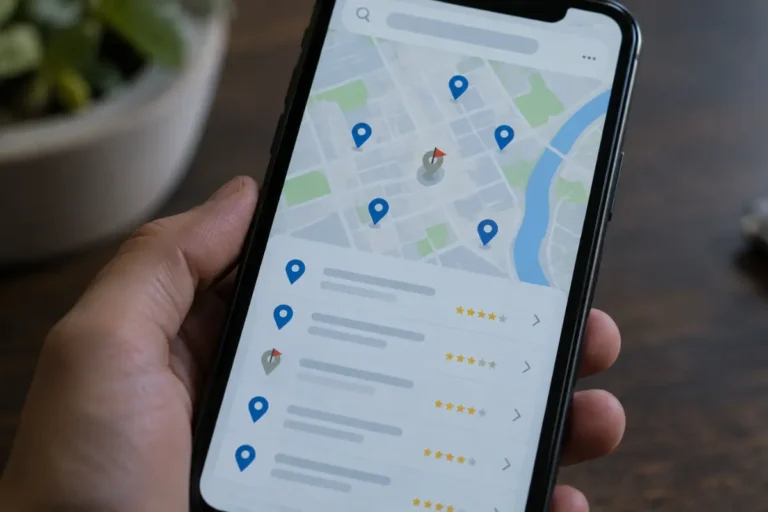
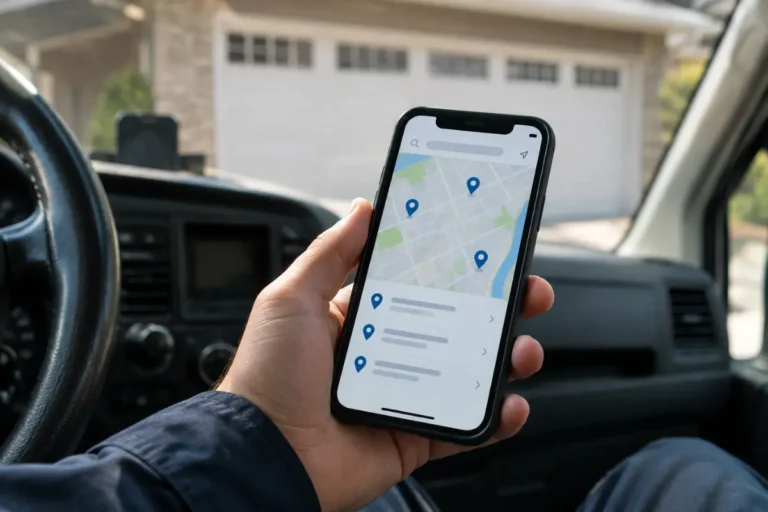
When a homeowner’s garage door spring breaks on a Saturday morning, their response has changed. Ten years ago, they would search Google for “garage door repair near me” and call a business from the map results. Today, more homeowners use ChatGPT or Google’s AI Overview to ask, “who fixes broken garage door springs near me,” and often choose the business named in the answer, sometimes without visiting a website.
AI SEO for garage door companies focuses on being recommended within AI-generated answers, not just appearing in search rankings. This guide explains what AI search values, how it differs from traditional local SEO, what an AI SEO engagement involves, and how to assess your current visibility.
Table of Contents
What AI SEO for Garage Door Companies Actually Means
AI SEO, also known as Generative Engine Optimization (GEO), involves structuring your website, listings, and content so that AI systems such as ChatGPT, Google’s AI Overviews, Perplexity, and Gemini can find, trust, and cite your business in response to garage door-related questions. While it builds on traditional SEO, including a fast, crawlable, mobile-friendly site, the primary goal is now to be cited by AI, not just ranked.
The Shift from Ranking to Being Cited
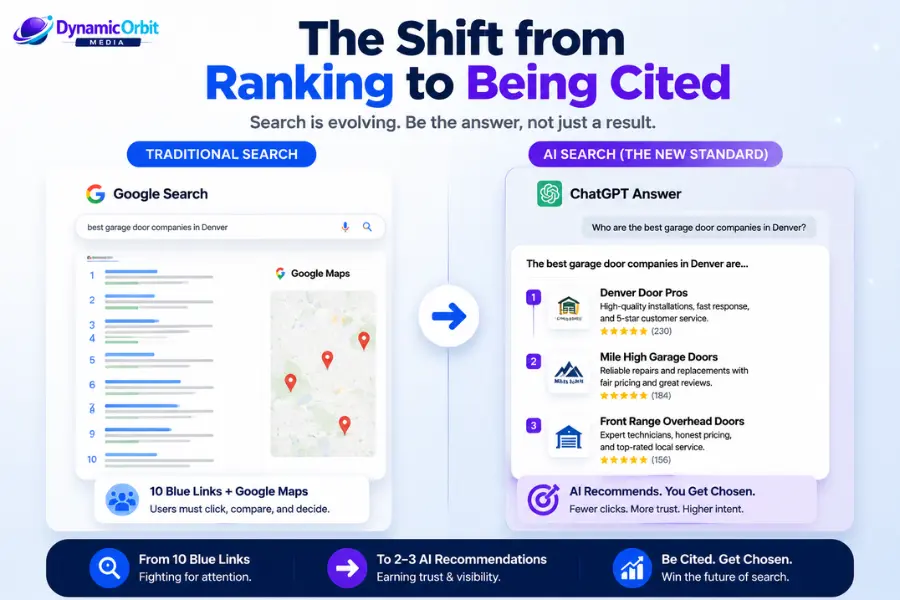
Traditional SEO measures success by rank position, such as being #1 or #3 for “garage door repair [city].” AI search, however, does not provide a ranked list. Instead, it reviews many pages, synthesizes an answer, and cites only a few trusted sources. A high Google ranking is irrelevant to AI if your page is not structured for confident extraction and attribution.
This represents a significant change. Academic research on AI answer engines (a widely cited 2024 Princeton/IIT Delhi study presented at KDD) found that pages with clear statistics and direct citations to primary sources are much more likely to be quoted than those using vague or promotional language. Pages overloaded with keywords performed worse. Today, structure and specificity are more important than domain authority.
Why This Matters More for Emergency Services Like Garage Door Repair
Garage door repair is a distress-purchase category. Issues such as broken springs, off-track panels, and malfunctioning openers require immediate attention, and most homeowners do not have a preferred provider on hand. This combination of urgency, low brand loyalty, and quick decision-making leads many to seek fast recommendations from conversational AI tools rather than browsing multiple search results. If an AI engine cannot easily verify your business, services, service area, and customer trust, it will recommend a competitor who provides this information clearly.
How AI Search Engines Decide Who to Recommend
Most AI answer engines use retrieval-augmented generation (RAG). The system searches the live web or a recent index for relevant passages, ranks them by relevance and trustworthiness, and generates an answer based on a select few. It typically cites or names only the sources it considers most reliable.
What ChatGPT, Google AI Overviews, Perplexity, and Gemini Look For
Several key signals consistently influence results across different engines:
- Direct, extractable answers. Content that presents answers clearly near the top of the page, such as a definition, price range, or step-by-step process, is selected more frequently than content that hides answers within lengthy introductions.
- Specificity over marketing language. Pages that list exact services, actual service areas, and physical locations provide concrete information for the AI to cite. Vague claims such as “top-rated garage door experts” cannot be verified.
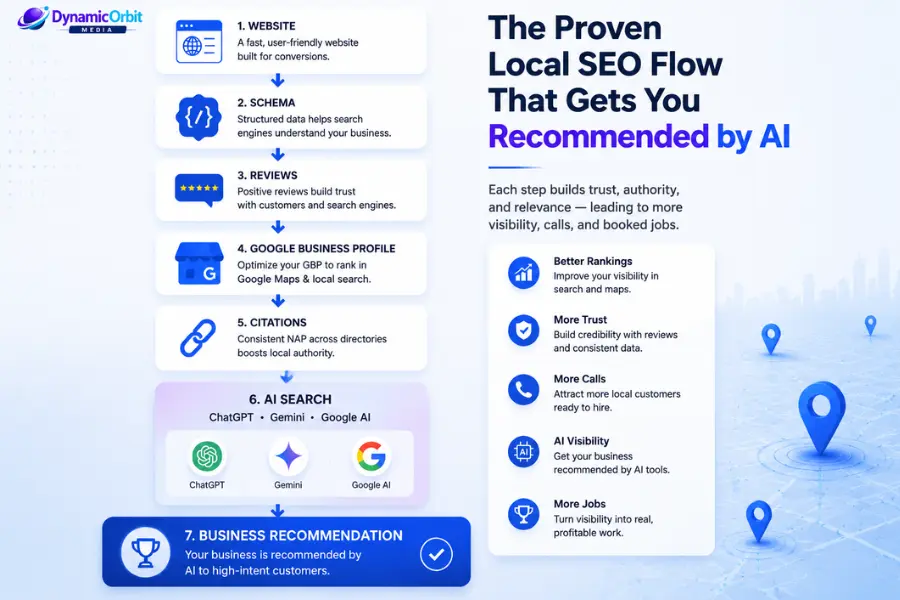
- Structured data. Schema markup clearly defines entities, such as LocalBusiness, Service, or Review, so the AI does not need to infer meaning from the text.
- Third-party validation. Reviews on Google, mentions in industry directories, and citations from other sites serve as references, allowing the AI to corroborate claims rather than relying solely on your statements.
- Freshness and consistency. Consistent business hours, service areas, and pricing across your website, Google Business Profile, and directory listings help the AI determine which information is accurate.
The Role of Structured Data and Schema Markup
Schema is the most effective technical tool for a garage door company because it eliminates ambiguity. At a minimum, an AI-ready site should implement the following:
| Schema Type | What It Tells AI Engines |
|---|---|
| LocalBusiness / HomeAndConstructionBusiness | Your business name, address, phone, hours, and service area as a verified entity |
| Service | Each specific service you offer (spring repair, opener installation, panel replacement) as a distinct, citable item |
| Review / AggregateRating | Star ratings and review counts that back up trust claims |
| FAQPage | Direct question-and-answer pairs that map almost exactly to how people phrase AI prompts |
| Article / author markup | Bylines, publish dates, and credentials that support E-E-A-T for blog and guide content |
The Role of Reviews, Citations, and Google Business Profile
Your Google Business Profile now serves two key roles: it remains central to the local 3-pack and is a primary trust signal for AI engines responding to local hiring queries. Maintaining consistent name, address, and phone (NAP) information, regularly receiving new reviews, and providing complete service and hours details all help reduce AI uncertainty.
Citations from directories such as Angi, HomeAdvisor, or local chamber-of-commerce sites offer additional verification that your business is legitimate and active.
AI SEO vs. Traditional Local SEO vs. Paid Ads
These three channels serve distinct purposes and are effective at different stages of the customer’s search process.
| Traditional Local SEO | AI SEO / GEO | Paid Ads (Google/LSA) | |
|---|---|---|---|
| Primary goal | Rank in the map pack and organic results | Get cited/recommended inside AI-generated answers | Immediate visibility for a fee |
| Best for | “Near me” searches, map pack visibility | Conversational, comparison, and “who should I hire” queries | Fast leads while organic/AI visibility builds |
| Cost model | Time/content investment, ongoing | Time/content investment, ongoing | Pay-per-click or pay-per-lead, ongoing spend |
| Trust signal weight | Reviews, backlinks, on-page SEO | Schema, E-E-A-T, third-party citations, structured answers | Ad relevance score, landing page quality |
| Longevity | Compounds over months/years | Compounds over months/years | Stops the moment spend stops |
Where Each Approach Wins
Paid ads are most effective when you need immediate leads, such as for a new location, during a slow season, or at launch. Traditional local SEO works best for homeowners actively searching and comparing options on a map. AI SEO is strongest with the growing segment of users who ask direct questions and act on the first business they are recommended.
Why They Work Best Together, Not as a Replacement
Each approach complements the others. A garage door company using paid ads for immediate leads, local SEO for map visibility, and AI SEO for answer-engine results reaches homeowners across all search methods. Increasingly, these channels direct customers to the same contact point.
Check Your Own AI Visibility Right Now
You do not need a paid tool to assess your current visibility. Open ChatGPT or Gemini and use prompts that reflect how homeowners would naturally ask their questions.
3 Prompts to Try in ChatGPT and Gemini Today
- “Who does emergency garage door repair in [your city]?”
- “What’s a fair price for garage door spring replacement in [your city/region]?”
- “Compare the top garage door companies in [your city] for reliability and price.”
Test each prompt and note if your business is mentioned, whether the information provided about your services, hours, and pricing is accurate, and which competitors are listed instead.
What to Do If Your Business Isn’t Showing Up
If your business does not appear, common reasons include missing structured data on your website, generic service pages lacking clear information, an incomplete or inconsistent Google Business Profile, or too few recent reviews for AI systems to verify your business. These issues can be resolved through updates and improvements, without requiring a full website redesign.
What an AI SEO Engagement Actually Includes
The following workstreams are not a separate contract. They represent the AI-visibility component of effective SEO or content engagement. This is now an essential part of ‘doing SEO properly in 2026,’ rather than an upsell.
Citations and Visibility Audit
Before making any changes, this step benchmarks your current position. It identifies which AI-generated answers mention your business or competitors, assesses existing schema on your site, and highlights inconsistencies in your business listings.
Entity and Schema Build-Out (Organization, LocalBusiness, FAQ)
This forms the technical foundation by implementing Organization and LocalBusiness schema, marking up each service as a separate Service entity, adding FAQPage schema to service and city pages, and linking review data with AggregateRating markup.
Answer-Shaped Content Creation
Content is rewritten or created so that the answer to a homeowner’s question appears in the first one or two sentences, followed by supporting details. This format is most reliably extracted by AI engines. It includes city-specific service pages, pricing guidance, and FAQ-style content that reflects real search and prompt phrasing.
Ongoing AI-Visibility Tracking and Reporting
Since AI answers evolve with new indexing and competitor updates, this process requires ongoing attention. Regular tracking includes prompt testing across engines, citation frequency, review growth, and traditional ranking and traffic metrics.
Real Results: What Garage Door Companies Have Seen
Ready to Get Found by AI, Not Just Google?
Homeowners seeking garage door SEO services are now receiving one or two business recommendations from AI platforms like ChatGPT, Gemini, and Google’s AI Overviews instead of a long list of search results. If your business isn’t optimized to appear in these recommendations, potential leads will go to your competitors.
At Dynamic Orbit Media, we help garage door companies adapt to this shift by implementing schema, review signals, and content designed for AI citation. Request a free AI visibility audit. We will evaluate your business using real homeowner prompts, compare your visibility to local competitors, and provide specific recommendations to improve your position. There is no obligation and no generic template.
What to Expect: A Realistic Timeline
AI visibility improvements accumulate over time, similar to SEO. Early technical fixes yield the quickest results, while citation frequency and rankings increase gradually.
| Timeframe | What Typically Happens |
|---|---|
| First 30 days | Schema implementation, GBP cleanup, citation consistency audit, baseline AI-prompt testing established |
| 60–90 days | New answer-shaped content published and indexed; early movement in AI citation testing and featured-snippet/AI Overview appearances |
| Long-term (6+ months) | Compounding review growth, broader third-party citations, more consistent appearance across AI engines and prompt variations, sustained organic and map pack gains |
Choosing the Right Approach for Your Business
DIY vs. Software Tools vs. Agency Support
| Approach | Best Fit | Trade-offs |
|---|---|---|
| DIY | Owner-operators with some technical comfort and time to spare | Free but slow; schema and content work has a real learning curve |
| Software tools (AI-visibility trackers, schema plugins) | Businesses that want structure without full-service management | Lower cost than an agency, but still requires someone to interpret data and act on it |
| Agency support | Businesses that want this handled end-to-end alongside existing SEO/ads | Highest cost, but typically fastest execution and ongoing accountability |
Questions to Ask Any SEO Provider About AI Visibility
AI visibility work should be included in your core SEO retainer, not treated as a separate line item. Use these questions to determine if a prospective SEO agency truly provides this service, rather than simply offering an ‘AI SEO package.’
- Can you provide examples of AI-generated answers that cite a client, rather than only showing rankings?
- How do you track the frequency of AI citations, and how often will you provide reports?
- Will you manage my Google Business Profile and review generation, given their impact on AI trust signals?
- How will your services integrate with my current local SEO and advertising efforts without duplicating them?
- If I end our engagement, will I retain ownership of my schema and content?
Conclusion
Homeowners now find garage door companies through two main channels: the traditional search-and-click method and an emerging conversational approach, where AI tools directly recommend providers. Success in traditional search remains important, but it no longer ensures visibility in AI-driven recommendations. Companies that AI engines confidently suggest are distinguished by strong schema, answer-focused content, accurate business data, and a high volume of authentic reviews.
These strategies do not replace your current local SEO or paid advertising efforts. Instead, they ensure your business remains visible in the fastest-growing segment of search. Begin by using the free prompt test above, address any issues, and monitor your AI visibility as you would your map pack rankings. Staying proactive will help you maintain an advantage over competitors.